[15 June 2022] Updated the note on graffiti.

I took this picture at the beginning of 2013 from inside the family compound where my Thai cousins live. It’s in Thonburi, off the Taksin Road, a few hundred yards south of Wong Wien Yai, the big roundabout with the memorial to King Taksin at its centre. In the foreground is the original family house, made of teak wood, but it has been gradually decaying and in recent years has become dilapidated.
The residential landscape is changing rapidly and there are now emerging some brand new high-rise buildings, mainly accommodation blocks. This one (which I hadn’t seen any trace of two years ago) is in the same soi, on land that used to be partly occupied by a primary school. Many of the new occupants have been drawn by the improved transport connections offered by Wongwien Yai BTS - no longer is there an hour-long wait in rush hours just to cross the Sathorn bridge as you can glide along in the sky train in a few minutes!
The land has been a naturally fertile environment, rich in vegetation, so when earlier generations made their homes here it was the most natural thing to plant seeds and to see everything grow so fast. Just imagine that when my grandparents moved here in the 1930s they were just finishing the Taksin Road, and this area was covered in orchards (with no vehicular access at all). Despite the heavy urbanisation of the area in recent decades, the family plot remains very green – my grandfather loved to cultivate all manners of plants and trees and more recently, in the 1990s, one of my cousins used to cultivate plants to sell in offices. That business is gone, but the tropical vegetation remains as a refuge from the concrete jungle.
However, what to do with the old teak house? It is quite dilapidated and there’s no one living there any longer – the last resident was my Aunt Umpai, who passed away just over a year ago. She used to live with her cats, many of which she had rescued, under the house because she had become too frail to climb the stairs.
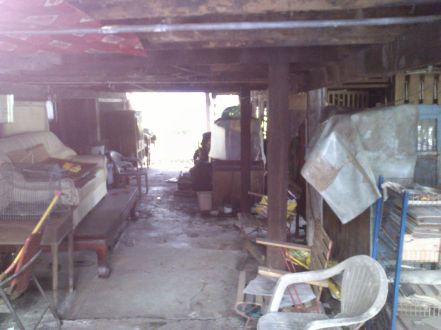
She often expressed embarrassment at how dusty and untidy it was, but in fact she was orderly, a discipline that came with her being a school teacher - in English grammar! She lived the last years of her life for her cats – she wouldn’t stay to converse for very long before asking to be excused so that she could feed them or otherwise tend to them.
However, when she passed away she left a lot more of significance to the family and a reminder of this came unexpectedly along an alley way. There’s a shortcut from the house down an alley – it’s quite narrow, but not narrow enough to prevent motorbikes weaving in and out. There’s graffiti on some of the walls, not pretty to look at, but turning a corner I was struck by the following:

The message scrawled on two lines in white (ช่วยกันรักษา ความสะอาด) translates literally as: "Let’s help each other to take care [of the environment] and keep it clean". It's actually a campaign slogan for letter disposal, similar to "Keep Britain tidy". Here, it's ironic, even moreso given that it's been partially defaced. However, the sense of taking care and preserving was pertinent to Aunt Umpai as someone who really cared about preserving heritage, having become the custodian of family history (though she was felt she couldn't maintain the environmental cleanliness as she would like). The next morning I started to explore the little home under the house, which still has many items, thinking that there may still be left behind some family heirlooms. I was especially interested in written materials - books, magazines etc – most of all in any family archives. I was fortunate to have with me as an assistant my niece, Baidoei, as she could translate for me (I struggle with reading even a few words, especially if they are handwritten). She remarked that some documents contain old Thai characters/letters with which she was unfamiliar.
We found many items lining shelves in bookcases and stacked up in piles, quite a number relating to Aunt Umpai’s teaching: various dictionaries, including Pali-Thai because she was interested in learning the meaning of the many Pali terms used in Thai. However, most of the reference materials concerned English language. In fact guests at her cremation ceremony were all given copies of the New Model English-Thai dictionary by So Sethaputra [published in 2547], with a brief memorial tribute inside. This was a contemporary twist on a distinctive and fascinating Thai tradition of cremation volumes. These volumes are really valuable for researching Thai family history, but I think they are still underused. See e.g. Grant A. Olson, 1992. Thai Cremation Volumes: A Brief History of a Unique Genre of Literature, Asian Folklore Studies,Volume 51, pp. 279-294,
And it seemed fitting that nearby these educational materials were piled up dozens of cremation volumes; we guessed that these would have been mainly colleagues and other people known to Khun Da (my grandfather). Most of the older items related to his life and work, including photographs – quite a few with Khun Yay Somboon, his wife, when they were young. There were accounts from his time in the army and then the prison services, some certificates of honour, including royal decorations and booklets of speeches given in the early days of Thailand's new constitution. There were some surprising finds, including a book with signatures of various notable figures, but I didn’t look closely to see whether it was actually an autograph book or just a collection of cuttings. Another volume was to commemorate the official opening of Thailand's Southern Railway, probably another interesting story that will never emerge.
Some items belonged to Fuengsin Sarayutpitag, my mother, including some school certificates, particularly a couple for Triam Udom Suksa, a preparatory school for entrance into Chulalongkorn University. There was also a book given by a friend, Khun Suchard, entitled วิธีทำงานและสร้างอัจฉริยภาพ , which means something like: Methods for Developing a Remarkable Aptitude in One’s work. It was by Poonsak Sakdanuwat (พูนศักดิ์ ศักดานุวัฒน์), who wrote commentaries on the Buddha’s life and also was interested in methods of mind development for business; the publisher was Wattana Panit (โรงพิมพ์ว้ฒนาพานิช). The book has a dedication about developing one’s career in a noble manner and it is dated 24 December 2501[1958], when she reached 22 years of age and was studying for her B.Ed. This discovery made me reflect that there might be quite a few literary items that Mum left behind when she came to the UK, in addition to the scrapbooks, which only arrived many years after she had emigrated, whilst we were in Hagley.
Unfortunately, many items had been damaged by insects, some completely ravaged. I collected a few of these and brought them into the home of my cousin, P' Laem, who had already salvaged some of the most important objects. However, there still remain others of value and I have been wondering how best to preserve them. The old house cannot remain for long in its present state, so my cousins and I are trying to figure out how to proceed; I feel there’s some urgency to remove what’s left and store this safely, at least temporarily. But what about the longer term? My mother left me a plot of land, part of which is located under the old house. To actually own it I would have to acquire Thai nationality, but I am already considering the possibility of building a small house partly devoted to family history for all my relatives to use.
Here I can take inspiration from another pile of books: Aunt Umpai was evidently impressed by the work of Mom Rajawongse Kukrit Pramoj, who was deeply committed to the arts and especially to Thai cultural traditions. I’d like any house to be largely of traditional design, but combined with modern conveniences and especially a library that has modern means of protecting its contents. It should also be harmonious with its surroundings and I'd like to retain the pond which partly covers the land.
I may be able to find some ideas from MR Kukrit’s Bangkok home, which has become a heritage museum. I’ve visited it and found it very appealing, especially the ponds in close proximity to the buildings.


The work on MR Kukrit’s home is ongoing and you can see the current projects on their Web site http://www.kukritshousefund.com/ .
There are numerous options. For example, should this be a carbon-neutral eco-home? In reality much will depend on the wishes of my relatives and no my budget…!


