Showing posts with label museum. Show all posts

Monday, January 18, 2021

Commitment to Research for Human Flourishing

In March 2011 Japan suffered a catastrophe with a massive earthquake off its East coast. A chain of events led to the Fukushima nuclear power plan disaster with the release of massive amounts of toxic radiation. I visited Tokyo a few months later, in July, when the city's population seemed subdued and fearful in a similar way to how many people have been with the Covid-19 pandemic.

I was hosted by Professor Yukari Shirota at Gakushuin University. In response to what happened, Professor Shirota made an emphatic statement, which I paraphrase: “Japan does not have much in the way of natural resources, only human resources. I therefore commit my life to research.”

Research is fundamental to human resourcefulness and is an activity that I would like to develop more effectively. Whilst research is a natural aptitude and I’ve long nurtured an interdisciplinary approach, I have only a very limited publication record despite having spent decades in academia; to earn a living I have served mainly in a technical support capacity.  I originate ideas quite easily, some expressed on this blog, but I have found it exceedingly difficult to gain traction for them.

Reasoning that I needed to devote more time to my endeavours, in July 2020 I decided not to accept an offer a 12-month contract extension to my post as Digital Projects Officer at the History of Science Museum (HSM).  Instead, I would work full-time on my research activities. However, I shall retain a connection following the award by Museum of the (unpaid) position of Honorary Research Fellow, which was approved by the Board of Visitors at their meeting last November.

There are several strands to my research that might benefit HSM. The most immediate concerns any digital aspects, particularly online communications, an area I have explored for a while and about which I will touch on below. There are other, broader aspects. In 2024 the Museum will be celebrating the centenary of its founding and I’ve already outlined some visionary ideas. I may take the opportunity to expand on them.

A number of my research strands have concerned aspect of science and religion, a broad theme whose historical development took a major turn in the 17th century, the century in which the original Ashmolean Museum was founded. The building now houses HSM, but it is still formally referred to as the ‘Old Ashmolean’. This was a period that saw the rapid rise of rationality; indeed, we denote this period as the Age of Reason. The consequences have been far-reaching, most especially in the increasing emphasis on materiality, which has pervaded notions of science and research in general.

I talk briefly about that development in Buddhism and Computing, the first tangible fruit of my research. A contribution to the ‘Mud Pie Slices’ series, it offers more than a slice of my thoughts from the past decade on critical issues around computer-based technology, particularly as manifest on the Internet. It has been a considerable challenge to squeeze in a wide range of topics without undermining the overall flow, but the issues are urgent and I wish to facilitate better access to them.

Buddhism and Computing summarises and ties together some of the main strands of my ideas in response to challenges facing humanity, concerning the freedom to think and act autonomously, the quality of awareness and so on. I conceived the Sigala project in sustainable online social networking as the primary deliverable in response to these challenges, but until recently I kept my research notes in local documents. I have now set up a website for the main body of research, research.siga.la.

Thus far the part-time efforts of one person, it has large gaps, is rough around the edges, out of date in details, lacks marketing (Why so few images? Where’s the explainer video? Etc.), yet it seeks to offer a coherent and humane vision. I’m hoping that once word gets around, the thesis will gain acceptance and the presentation strengthen, and so on.

For me the process started in November 2007 when I started to reflect on what friendship truly means and how best to support it online. Initially, I conceived this in educational terms, but very quickly saw that its scope was universal.

Having been introduced to the Internet in the early ‘90s in the context of research, I have been strongly averse to the way the Internet, particularly the Web, has been commercialised.  Browsing the Web today with its numerous interruptions, whether for legal consents or advertising, do not make for an aesthetic experience.  Furthermore, changes in search indices and results generation, favours organisations, particularly corporates, and has diminished the voice of individuals; all told, it has generally become harder to find high quality and truly diverse materials.  

Nevertheless, we need viable economic models and I see great potential in applying the work of Avner Offer, who recognised a spectrum from the gift to the market in his theory of the 'economy of regard'.  I’d like to incorporate this in Sigala.

I will elaborate on the substance of the project in future blog posts. For now, I just mention in passing that the website is a kind of knowledge base, whose process is ongoing. As explained, I author and manage the content on my laptop at home using a locally installed WordPress, a web content management system whose popularity is due in no small part to the fact that it is open source software.

Using this setup has yielded the first technical fruit. Running to a few dozen pages, the site is not large or complex, but there is a lot of text, so it may take some while to browse to find something specific. So, as with most websites, a search facility is provided. However, I’ve taken an existing search plugin, WP Static Search, and modified it to work offline, i.e. without an Internet connection or web server. I’m only an occasional coder, but have uploaded my changes to Github and submitted a pull request. This means you can download the entire site onto a memory stick and browse and search it there. (Just one tip: when downloading the zip file from Github, the plugin folder should be renamed back to ‘wp-static-search’ before deployment.)

However the research proceeds, I shall always be looking for opportunities to innovate!


Friday, January 03, 2020

Universitas and communitas at university museums

Updated 5/1/2020: I've reverted most of this to draft status as I ponder further...

In recent decades the public-facing role of university museums has greatly increased. Expectations are for this to keep growing.  At the same time, as part of the university, they have certain obligations; they need to fulfil the purpose of such an institution and to respect the wishes of founders and donors.   So in this follow-up post to my vision for the History of Science Museum in Oxford, I wish to reflect on what role a university museum might have with respect to members of the public and systems of belief, and how it might continue to develop and flourish whilst being true to its roots.  As before, they’re just my personal views, not necessarily those of the Museum or the University.

The early stages of Oxford’s medieval formation were characterised by universitas, a Latin term used for a gathering or community of scholars in higher education, who were  training in holy orders, for the religious life.  The word is properly contextualised in the phrase, universitas magistrorum et scholarium, and connotes the whole, or entire.  This holistic approach to learning has been a core foundation sustaining the academic institution for some 800 years.

At the heart of its operation is communitas, another Latin word, which may be defined [from etymonline's entry for  'community'] as "community, society, fellowship, friendly intercourse; courtesy, condescension, affability," a deep sense of collegiality, a community in spirit, not just in form.  These general principles foster an ethos, which is more than any of the individual terms.  The word commonly used today is ’community’, but it tends to be materialised with reference to a particular group, where the inevitable question is, ”Which community?” followed by “What about that community?”...


Sunday, December 01, 2019

A Vision for the History of Science Museum

[Updated 21/12/19 with a reference under 'Validation' to Einstein's Blackboard,
23/12 added a note about the Steampunk exhibition,
27/12 added references to work of Stafford Beer and the Viable Systems Model
14/1/20 added a photo of IBM Q and a paragraph on a VR time machine, 

9/2/20 inserted a paragraph on how to be small - with thanks to Prof. Jim Bennett,
17/4/20 added a brief mention of Covid-19 to illustrate 'history in the making'
plus a few other minor changes.
15/7/21 added material contributions as part of History in the Making]


Apart from two years in Doha, I’ve been working at the History of Science Museum in Oxford since 2009.  With the prospect of its centenary in 2024,  I have been nurturing some thoughts about what it might become.  They’re just my personal views, not necessarily those of the Museum or the University.  (To put this in perspective, my job title is Digital Projects Officer - I'm not a board member, senior manager, curator or collections specialist.)

One of the main challenges is to properly accommodate such a wide range of scientific instruments, whose breadth should be readily apparent in the collection areas.   I favour larger premises and a few years ago pondered the conversion of the Osney Power Station, whose generous space and impressive architecture seemed to offer stunning possibilities - of bringing together the history of science, the latest developments in science and innovation, and community engagement, apprenticeships and so on.  Furthermore, the building itself had played an important role as the Southwell Laboratory, used by the Department of Engineering Science.  It even had a wind tunnel.  However, with the future of that building now determined, how might we accommodate such elements in the existing Grade I listed building on Broad Street?

Themes

Currently, many museums are working on themes, inspired by the Rijksmuseum Boerhaave, which was elected European Museum of the Year 2019.   Our collections are as broad, but our space is less, so we need fewer themes whose titles are more abstract, which we might call 'meta themes'.   Abstract terminology, if meaningful and used well, can be immediately intriguing and prompt interest and enquiry, as with notions of architecture at the University Museum, Tokyo.

Accordingly, I would like to propose three new themes, though most of my deliberations have been only on the first:

  1. 'History in the Making':  the main thrust of this is to keep in touch with current research and development, especially across the University's science departments.  An obvious example is Covid-19, the deadly novel coronavirus strain that has brought much of the world into lockdown. At Oxford there are hundreds of people involved in specialist endeavours to understand and treat the virus.  Whilst the media are focused on the immediate medical emergency, still many others are looking at the wider impact on society, which surely benefits from a historical perspective.

    So imagine a circulatory system continually supplying information on the latest research, coming together at the Museum, and being distilled for public consumption, assisted by AI, and then feeding responses back to the respective departments.   It was Rupesh Srivastava at NQIT whom I first heard use this phrase, when he suggested bringing into focus current research, whose discoveries are already entering history books - in his case relating to quantum computing.

    IBM Q quantum computer on display at Oxford University's Beecroft
    building (Department of Physics) reception area, June 2018
     
    The title is open to many interpretations, allowing us to use any number of scholarly methods, such as Philosophy of Science, to analyse the conditions and processes that support ingenuity and innovation, whilst also looking at the implications for society as a whole.  Also 'making' is a very relevant word because we are a museum of scientific instruments, all of which have makers and a process of production, along with various other provenance.  It should appeal especially to loyal members of the Rete mailing list.

    Furthermore, the Museum's collections can benefit directly in terms of the material culture.  The  processes that feed information about research can include inventory details – not just the objects used in the experiments, but also their functions, the processes in which they are involved and their environmental properties, including indications of hazards.  An ontology can be developed and refined on an ongoing basis.  This will enable the Museum and other interested parties to see at a glance what departments and teams are engaged in, the materials they are using, the processes planned and underway.  Fresh insights may be gained in high-level considerations of the processes intrinsic to scientific research. 

    Stock control will be incorporated into the system (think about order fulfilment in online shopping), so we know the shelf life of equipment, when it is due to be replaced and the on-site movements.   This will have many practical benefits.  As breakthroughs are made, the Museum will already know what’s involved and be able to anticipate what equipment and samples will be reaching end of life and thus be in a position to enquire about possible accessions.  There will be no need to be reactive and make hasty decisions if, for example, recycling people phone up and say, “We’ve got this… are you interested?”

    This theme will also be great for launch day as it will itself mark history in the making.  It should also be chosen on a date of astronomical significance.  How about Wednesday 20 March 2024, the spring equinox, an expression of being in balance?

    Location: the entrance to the Museum, currently the Entrance Gallery on the first floor, as it's the nearest contact to the outside world.  Many metaphors apply such as 'keeping in touch’, encountering the surface and then as you move into the building, you go back in time and deeper into the foundations of the subject matter.  It would sit well with the shop, which is usually near the entrance, offering a bright welcome and a fond farewell.   (In the process of thinking afresh, we can also become more mindful of why things are laid out the way they are.)
  2.  
  3. 'Voyages of Discovery: Inner and Outer Worlds': Again, laden with multiple meanings, this covers scientific 'voyages' as in theories, methods, experiments, etc., and the physical voyages that used these instruments.  'Inner and outer' allows equipment to range from microscopes to telescopes.  Going beyond equipment, there are more symbolic meanings concerned with other kinds of investigations, such as what it means to be human and the nature of ‘science’ across history and cultures (the inner voyage into mind, soul, etc.).

    In this connection, we may explore the popular theme of science and religion.  Established religions are already being engaged in dialogue through the Ian Ramsey Centre for Science and Religion, but many people regard themselves as spiritual and do not relate to organised religion.  They may be interested in psychic phenomena, angels, telepathy, near-death experiences, and so on.  The Museum does have some relevant objects, so I feel there is a need to learn from another organisation, whose roots lie in the work of Sir Alister Hardy, who had a distinguished career as a marine biologist.  However, he also had a deep interest in spiritual phenomena, establishing the Religious Experience Research Unit, which built up a database of reports from individuals who had these kinds of experiences.  It's now the Alister Hardy Trust and Religious Experience Research Centre, which recently celebrated its 50th anniversary.

    In a short biography of Sir Alister for issue 67 of De Numine, its journal, Ben Korgen writes that after his retirement that:

    If Hardy had been less well known, his colleagues might have brushed this off as just another hobby or as a topic for casual conversation.  Hardy was different.  He was a world renowned scientist, he had been knighted, and as the Linacre Professor of Zoology at Oxford, had become an influential spokesman for the life sciences.”

    Coincidentally, the Director of the Museum is a Fellow of Linacre College.  Why not develop the Linacre connection further?

    Location: Basement Gallery, the bowels of the museum - plumbing the innermost depths!
     
  4. 'Knowledge as Art': Aesthetics, works of beauty using precise methods, fine materials, embellished and sublime, often with reverence to the divine.  A bridge between science and art that's not confined to any one particular period (e.g. medieval astrolabes or Renaissance globes), but is evident throughout history.  Arguably the most successful exhibition we’ve ever had in engaging and enthusing the public was inspired by the Victorians: Steampunk saw people queueing around the block.

    This theme may be developed with special attention to the physical-digital spaces.

    Location: Top Gallery, the lightest and airiest space, as befits celestial aspirations.
     
  5. Experimental zone’: a fundamentally immersive digital environment in which to explore our digital collections or recreate scientific experiments, incorporating enhanced 3D and kinaesthetic experiences.  Not a core theme, it serves to support the others individually and as a whole. 

    Although I'm not a big fan of virtual reality (VR), it might be a fitting place to install a VR time machine in which one takes a seat and, as in H.G. Wells' novel, play the part of a Time Traveller, particularly as this space presently houses Cyril Beeson's horological collection.  As one turns back the clock, scenes unfold gradually, giving witness to the Museum's remarkably varied history over the centuries: its spaces - as laboratory, teaching space, etc. - and its protagonists, such as Elias Ashmole, the founder, its scientists, curators and other occupants.  Plenty of scope for interaction.

    Location: Beeson Room

Validation

For the themes to be well-grounded, an audit of the collections is needed to ascertain relative strengths and weaknesses – there may be some surprises!

Consistent with our primary responsibility of preservation, once we’ve come up with a set of themes, we may test their coverage by seeing if it accommodates each of our past exhibitions and displays.  It should in particular encompass objects featured in the audio guide.  So, for example, we may test against the most popular of these, which is consistently (according to Front of House) Einstein's Blackboard, and we see that it's readily satisfied by applying 'Voyages of Discovery: Inner and Outer Worlds' - the mathematical equations represent the expansion of the universe, measuring both density and distance.

The blackboard is arguably our 'unique selling point' (USP).  It was even a catalyst for its own exhibition.

Development of the Themes and Sustainability

Themes must also be sustainable - not only financially, but also in terms of being properly embedded in the University's wider functioning. So the science departments should be involved, especially in co-creating 'History in the Making'.  Taking the cue from the Boerhaave, Museum staff can visit each department and invite their views on what they'd like to see at the Museum, how they may be assisted in reaching various audiences, the kinds of programmes that might be done together.

Having conversed with the science departments, other subject disciplines can be brought in, shaped overall by the discipline of 'history of science' and the set of values (to be agreed) - I'm certainly not a specialist in this field!   To help with manageability, a special project could be set up to devise new kinds of processes, working towards a kind of evolutionary cycle such that any new initiative will be seamlessly incorporated with supporting materials, ready for further analysis so as to enhance our existing state of understanding.

This leads to broader organisational considerations and arguably the greatest challenge: long-term economic viability.  So it’s perhaps here where we might expect the most radical transformation.  In that spirit, I suggest that ideas of circulation and cycles should be likened to a responsive living organism and the inter-relatedness of its organs.  It prompts me to recall a conversation with the late Alfred Crabtree, FIProdE, an engineer and management consultant, who introduced me to the field of management cybernetics.  He lent me his copy of Stafford Beer’s Brain of the Firm, a seminal work that proposes the Viable Systems Model for organisational design, with the ability to continually adapt to environments they cannot fully control.

There’s a nice explanation provided by Metaphorum, an open society that seeks to further these ideas.  We can see that the model consists of a number of inter-operating subsystems that exhibit a set of characteristics vital for sustainability.  According to this model, the operational subsystem comprises largely autonomous operational units, which applied to our scenario of ‘history in the making’ would include what we might call ‘input streams’ from each science department providing resources.   HSM management would foster the ethos, coordinate and ensure harmony between the respective components: one of the subsystems is in fact devoted to ensuring working together in symbiotic relationships, internally and externally.

There is also emphasis on balance, which readily applies to curation, where there is a need to ensure consistency of the information and fairness in interpretation.   It also applies at higher organisational level: to be feasible the model has to be properly representative of all parties, particularly for the science departments, which may mean that the model has to scale up to the University.  (It might be interesting to use the VSM to assess the highly devolved organisational structures that have evolved over the centuries compared with the more centralised modern ones.)

In terms of the relationship with other heritage institutions, the museums sector, I am pondering thoughts offered by Professor Jim Bennett, former Director of the Museum on how to be small.  Being small places importance on being different, of doing our own thing, and risking something original (as he articulated in an interview about the Steampunk exhibition).   When other museums copy the idea we know it's been successful, but even if it doesn't work out then we can learn from our mistakes and move on.  It motivates being more distinctive and experimental, like a laboratory - with the obvious historical allusions to the building's earlier usage - that generates ideas for the sector.  I see it as a kind of museological maquette, where various creative ideas are tried out on a small scale without being onerous.  It would apply not just to the Experimental Zone, which would seem a natural fit, but to the Museum as a whole.

On a ‘revolutionary’ note, Stafford Beer was invited in the early 1970s to apply cybernetics to Chilean society, resulting in Project Cybersyn, an attempt to implant an electronic "nervous system".   Whilst that particular project was abruptly terminated, the appeal to biological systems was echoed by Bill Gates in his promotion of a ‘digital nervous system’ in the late 1990s.  This ecosystem permeated the entire Microsoft global business and evidently was immensely successful.


Whatever the vision and themes to realize that vision, their fulfilment will need clarity and considerable synergy.  It is in many ways an architectural challenge of the mind, where the designs are to support an intellectual apparatus where the development of scientific knowledge is treated as a whole, operating in a continuum across the full spectrum of human history.


Friday, July 13, 2012

First Impressions of Qatar

I started work on the 1st July and two days later received this memento:


It is from a party I attended along with colleagues to congratulate a senior member on their new appointment. The occasion seemed more akin to a wedding reception - complete with guest book - and illustrates, I feel, the kind of welcome that local people like to offer. :-) I think hospitality has been a long-standing custom in this area, a tradition expounded in the recent exhibition called The Gift of the Sultans . (I'm particularly interested in gift exchange as I think its importance is growing in wider economic development.)

If my copious notes are anything to go by, there's been a lot to interest, perplex and marvel in my first few days.  At the party I did not escape having a microphone shoved into my hands, and all I could really say is that it's been somewhat overwhelming experience to take everything in, but it has been actually quite wonderful - that is, there are many things to wonder at. Before I arrived I had been reading a little bit about the geography and history and had a sense of very quiet and simple existences - of Bedouin tribes and pearl fishing villages.  So when I see all the development, the contrast is striking; it seems even more marked than the modern urbanisation of Bangkok in the '80s and '90s because here in Doha 10 years seems already a long time ago.  This is especially so in terms of staffing: having just come from Oxford, where departments could have half a dozen staff with 150 or more years service between them.   In Doha, I guess this would be unheard of, so you really feel the newness of this incarnation!   In such a short timescale without really knowing what the future will bring it's inevitable that some construction plans are made somewhat hastily, but the overall direction towards a 'knowledge economy' and the investments in arts, culture and education seem laudable and I think will bear fruit.

I've seen or met quite a few people, yet I've hardly made any excursions.  When I asked about getting out and about on foot or by bus, I got a doubtful look; it does seem that most people just drive or use drivers, though I did see a few Mowasalat and other buses go by, particularly US-style yellow school buses.  It's really the multitude of people who have been passing through the hotel and whom I've met at the workplace.  For instance, some reception staff are from countries in Eastern Europe such as Ukraine and Belorus; many Filipinos act as drivers and also room service staff; there are also Indonesians, particularly from Bali.   I met one staff member from Nepal and he had relatives in the UK (and knew about Joanna Lumley's support for the Gurkhas!)  Other drivers are from North Africa - e.g. Sudan - and South Asia, e.g. India and Pakistan; you soon realize that there are several continents and many nationalities within 3 hours flying time.   This is also reflected in the hotel laundry list, which for men includes items such as dish dash, gutra, Gahfia cap, and serwal.

At the office my colleagues (some of whom are on LinkedIn ) are from states/countries such as Qatar, US, Canada, India, Syria, Egypt, and Eritrea.  Several of my non-Qatari colleagues that they were born or brought up in Qatar, which initially surprised me, but then on reflection that is to be expected because, I think, for several decades the expat community has outnumbered the Qatari citizens.  Now the population of Qatar has exceeded 1.7 million, about 80% of whom are expats, many from other Arab countries, plus South Asia and the Philippines, whilst Westerners make up only a small minority.   However, I've not encountered so many people who are like myself of mixed ethnicity, at least not many in comparison with the UK, whose diversity has come from long-term immigration especially through Europe and Commonwealth connections.  I think that reflects the Islamic code of conduct around marriage, which is stricter than in secular society, plus the fact that many immigrants come here for relatively short contracts and ethnic communities here may be quite self-contained, though I don't know.

I work fairly standard office hours - compared with my previous jobs I start  early and finish early leaving plenty of time for the rest of the day.  However, some hours of work are evidently much longer: I was concerned to hear one driver declare that he offered a 24 hour service - "you can ring me at 2am and a driver will be there within 15 minutes."   "When do you sleep?" I asked.  "During my holidays!" came the reply.  In effect, when not driving, he's on call all the time.  Yet he was recommended to me because he has a reputation for being reliable.  I hope he doesn't get so many night time calls.

The Qatar Museums Authority is a quite large organisation with headquarters in a tower block; I use the staircase to get some exercise (10 flights of stairs to the floor where I work); so far I just walk, but one of my colleagues has been running and can race up them in 2 minutes or even less!

Here is a promotional video made in-house with QMA staff, aimed particularly at University students.


QMA has some UK links, particularly with University College London.  Here is another video, describing the partnership with the Qatar Foundation, Department of Culture and QMA:


The fields of cultural heritage and archeology seem to me a good match!


I never thought that I would become an expat - but somehow it happened.  You get a few reminders of your new offshore status, such as visiting UK news sites which display adverts offering super-charged pensions and salary schemes, trying to entice with "Free Report for BBC Readers in Qatar" or "Create your own personalised high interest offshore savings and investment design today!"  I think I'll stick to something simple, though I shall need to open a bank account soon, now that my residency permit and ID card have come through.

So far my experiences have been very positive - the Qatar I've experienced is buzzing with optimism, a 'can do' attitude.  And lest I get too busy, I can recall the words of Desiderata.

Friday, June 22, 2012

Last Day at the Museum of the History of Science

MHS banner from Winter 2010-11 advertising a 360 degree panoramic tour

Engraving of the East Front of the Museum by Michael Burghers, 1685Today was officially my last day as Web Officer at the Museum of the History of Science in Oxford, which has the distinction of being housed in the world’s oldest surviving purpose-built museum building, the Old Ashmolean, an early impression of which is as right.
I had the pleasure of working there since October 2009 with a close-knit group of dedicated, friendly and enthusiastic staff with a wide range of interesting backgrounds. So I was sad to leave and surprised how difficult it was to hand in my keys and especially the University card - I felt quite bereft as though I had lost part of my identity.

I found the Web Officer role similar in many ways to a previous one where I was responsible for anything Web-related; it requires some flexibility as the duties are varied, ranging from system administration (at the command line) and documentation through to some elements of graphic design, particularly image composition. In summary I would characterise much of the effort as consolidation - in terms of the Linux-based hosting provision, and the use of WordPress as the gateway to the entire online presence.

WordPress gets used mainly for blogging, albeit with resources built around it, but at MHS it is used as a content management system. Perhaps the most significant development was the integration of the KE EMu collections management system, for which I prepared the following slide for the 2011 KE EMu User group meeting, held at the Natural History Museum.
A lot of the work was behind the scenes. A particular challenge was search engine optimisation (SEO); it took me a long time to realize that a WP upgrade had inserted canonical URLs into the header, leading to just a handful of collections pages being indexed. Once I had removed that and made the page titles more distinct the index grew and more visitors came.

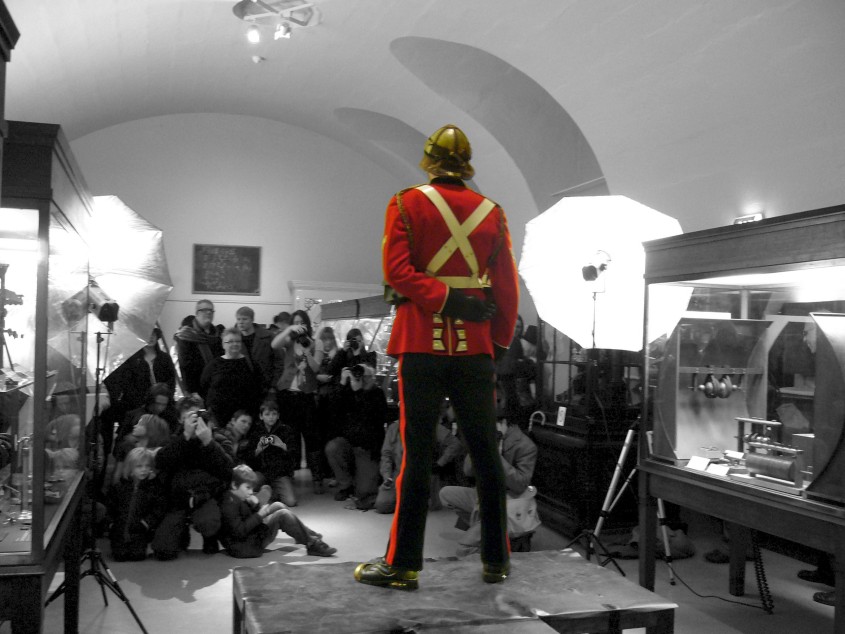
Just occasionally I could do something a little different. For instance, when faced with slightly blurred image, I suddenly realized an opportunity to create an inverted reflection in time for the somewhat wacky and hugely successful Steampunk exhibition:

Steampunk Live Mannequin
(I manually traced the figure; some regions have little contrast so I suspect an automated tool would probably struggle)

The old uniform is brought into the present, whilst the photographers (who strive to capture the present moment) recede into the background, into the past, by being faded to grey.

Now too my fleeting role as Web Officer will start to become a faded memory. However, I'm not leaving the museums world, as soon I shall start another role, supporting not one but many museums ...

Friday, January 14, 2011

Somboon Sarayutpitag and Satriwithaya School

In recent trips to Thailand I’ve been learning how my maternal grandparents greatly valued education. I’m sure they were a strong influence on my mother, Ajahn Fuengsin, who acquired a lifelong interest in learning and transmitting her knowledge through teaching (Ajahn is a general prefix for an established teacher).

My grandfather had been awarded the title of 'Luang', so he was subsequently addressed as Capt. Luang Sarayutpitag (he had been a captain in the army). The distinctive Thai surname seems to have been spelt in more than one way; my cousins generally insist on ศรายุธพิทักษ์ but there are several letters that can represent an ‘s’ sound and an extra ท ('t') seems optional, so sometimes it has been written สรายุทธพิทักษ์ (with an opening ส instead of ศ). I expect that if one knows the roots of Thai language (Sanskrit, Pali and so on), then one can work out the appropriate letter, but I guess that might be like asking someone in the UK to distinguish between Greek and Latin etymology...

Anyway, prior to this visit, I had heard that my grandmother, Khun Yay Somboon Sarayutpitag, had attended the same school as the Somdet Ya, the Princess Mother (the mother to H.M. King Bumiphol). This school was called Satriwithaya School, a girl’s school in the heart of Bangkok. Some time last summer I started typing into Google ศรายุธพิทักษ์ and สรายุทธพิทักษ์ and a few permutations.  Eventually I came across the Web site of the Srinagarindra [Somdet Ya] museum, the museum of Satriwithaya School, set up in honour and memory of its most famous pupil. Google had spotted an occurrence of the name in the following paragraph:
สิ่งที่เป็นจุดเด่นของพิพิธภัณฑ์สมเด็จย่าคือ พระบรมฉายาลักษณ์ ที่มาของภาพเก่าอันทรงคุณค่าของสมเด็จย่า ส่วนหนึ่งมาจากศิษย์เก่าและครูเก่าเก็บไว้ และอีกส่วนหนึ่งได้ไปขอมาจากสำนักพระราชวัง หนึ่งในรูปภาพที่ทรงคุณค่าอย่างยิ่งคือภาพถ่ายหมู่ของนักเรียนชั้นมูลปีที่ หนึ่ง(ปัจจุบันคือระดับอนุบาล) ถ่ายวันที่ 9 มีนาคม ร.ศ.127 (พ.ศ.2451) สมเด็จพระศรีนครินทราบรมราชชนนี ครั้งยังทรงเป็น ด.ญ. สังวาลย์ โดยพระองค์ประทับในแถวกลาง เป็นลำดับที่ 3 จากซ้าย ซึ่งภาพต้นฉบับสีซีดจนอ่านตัวหนังสือบนแผ่นกระดานที่แขวนไว้ด้านหลังนัก เรียนไม่ออก ต้องใช้คำบรรยายที่เจ้าของภาพเขียนติดไว้ด้านหลังภาพ ภาพนี้ได้รับความอนุเคราะห์จากทายาทนางสมบุญ ศรายุทธพิทักษ์ ในภาพมี ด.ญ.สมบุญอยู่แถวหน้า ลำดับที่ 6 จากซ้าย ส่วนด้านขวาสุดคือครูทิม
My attempted translation is as follows:
A prominent feature of the Srinagarindra [Somdet Ya] museum is the Royal source of some valuable old pictures of the Princess Mother. One part comes from the collections of alumni and former teachers, and another has been requested from the Bureau of the Royal House. One exceedingly valuable picture is a group photograph of first year pre-elementary students (now equivalent to kindergarten) taken on the 9th of March R.E. (Ratanakosin Era) 127 (B.E. 2451). The Princess Mother [can be seen] at the time when she was still a girl, Miss Sangwan; Her Royal Highness is residing in the central row, 3rd from the left. As an original picture it is extremely faded to the extent that it is not possible to read the writing on the plate mounted on the board behind; it's necessary to use the description that the owner has attached on the back of the picture. This picture was received with the assistance of the descendants of Mrs. Somboon Sarayutpitag. In the picture Miss Somboon is in the front row, 6th from the left.

The next paragraph presents an invitation:
สำหรับ ผู้ที่อยากชมภาพนี้ มีภาพขยายใหญ่เกือบเท่าตัวจริงติดอยู่ในห้องเอลิซาเบธ ซึ่งเป็นห้องประชุมของโรงเรียน ห้องนี้มีขึ้นในช่วงที่ควีนเอลิซาเบธที่ 2 เสด็จมาที่โรงเรียนสตรีวิทยาในวันที่ 30 ตุลาคม พ.ศ.2539 เพื่อทอดพระเนตรกิจกรรมและนิทรรศการการป้องกันยาเสพติดในสถานศึกษา พระบรมฉายาลักษณ์สมเด็จพระราชินีนาถ เอลิซาเบธที่ 2 พร้อมพระปรมาภิไธยที่ได้รับพระราชทาน ขณะนี้อยู่ที่พิพิธภัณฑ์สมเด็จย่า
 In approximate English:
For those who want to look at this picture, there is a near life-size enlargement on display in the Elizabeth room, which used to be the school assembly hall. This room was set up on the occasion of the visit of Queen Elizabeth II to Satriwithaya School on October 30 2539 to observe events and exhibitions relating to drug prevention in schools. The picture of Queen Elizabeth II, together with her signature, is in the Srinagarindra Museum.

I soon found a copy of the photograph online in the Wikipedia entry for the Princess Mother. However, having read the description above I thought, "I’d really like to see this picture for myself at the school!"

I was fortunate. I got in touch with my cousin, P’ Laem, and he made enquiries through an aunt who used to teach there. Soon arrangements were made and we went along to visit one Friday afternoon in late November. Designed around a courtyard, the buildings rise on three sides to several storeys, having expanded considerably since its foundation over a hundred years ago. When we arrived the school was still bustling with activity; at the entrance there was a large tree occasionally shedding its leaves under which a group of pupils was anticipating its every move ... and then a leaf would come sailing down and they’d try and catch it. Later when we left there were just two girls by the tree, still playing the same game!

On the left hand side as you enter there is a status to the Princess Mother:

statue of the Srinagarindra (the Princess Mother) at Satriwithaya School
The inscription says it is dedicated to สมเด็จพระศรีนครินทราบรมราชชนนี (Somdet Phra Srinagarindra Boromarajajonani), giving the dates she was alive (B.E. 2443 – 2538, i.e. 1900-1995CE). It was unveiled by สมเด็จพระเจ้าพี่นางเธอ เจ้าฟ้ากัลยาณิวัฒนา กรมหลวงนราธิวาสราชนครินทร์ (Somdet Phra Chao Phi Nang Thoe Chao Fa Galyani Vadhana Kromma Luang Narathiwat Ratchanakharin). This is the full title of HRH Princess Galyani, the elder sister to H.M. King Bhumipol. P’ Laem informed me that she took a great deal of interest in the Royal family history and was particularly interested in the school. The statue was unveiled in B.E. 2543 (2000 CE).
We were shown inside the museum by a librarian and directed to a number of books on the table. These contained further photographs and descriptions. We learnt that at the time that group photo was taken, Khun Yay Somboon was 14 years old and the eldest in the group. Afterwards we were led to the Queen Elizabeth Room, which now serves as the board room, where the enlargement has been placed on the wall. Here it is (clicking on it will take you to the version on Wikipedia):

Satriwithaya School group photograph, 1908
This photo was taken in 1908, right towards the end of the reign of King Chulalongkorn (Rama V). Thailand's process of modernisation through especially European influences is evident in the uniform: you can see the children wearing the traditional jongraben, but also Western style shoes and socks!

Thailand’s tropical climate is very severe on paper, yet the photograph itself is in very good condition. How come? P’ Laem explained that Khun Yay Somboon had cherished this photograph very much and took special care of it. His parents had built their home very close to the grandparents’ house and P’ Laem’s room was almost opposite Khun Yay’s. He could see it hanging at the back of the room as Khun Yay emerged onto her balcony. The positioning was deliberate!

The Princess Mother subsequently went on to Chulalongkorn Hospital to study nursing. Khun Yay also had an opportunity to study there but declined, apparently afraid of the ghosts! Thai people are generally sensitive to spirits, but this response surprised me as she was certainly a strong character, as I hope to convey in a future post or two...


Postscript [August 2012]:  Please note the primacy in spelling of ศรายุธพิทักษ์ over สรายุทธพิทักษ์ - previously I had got it the wrong way round!  Sorry about that.